

We just went through the latest listings of food and health inspections by the Grays Harbor County Division of Environmental Health.
Please keep in mind, these reports are just being made public, and most establishments have most likely already corrected most issues that they faced. This is all the information we are provided with, so please do not ask much more as far as what the violations were for, etc... For more information, you can contact the Grays Harbor County Division of Environmental Health at (360) 249-4222 or

Before making a judgment on any violations, we encourage our readers to follow up with and check out the actual violations.
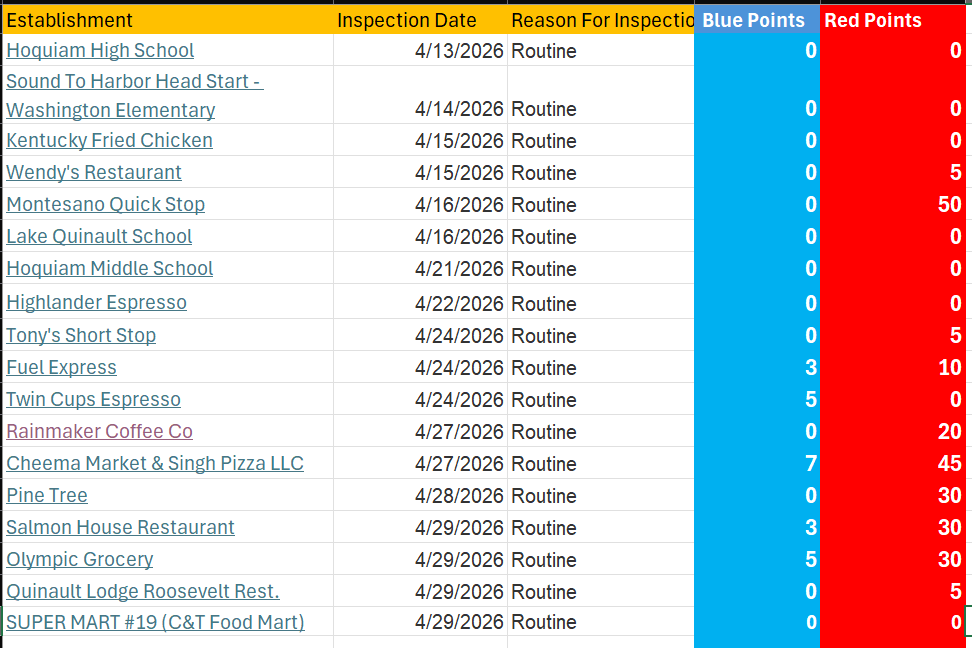
Most notable inspections are listed below
Montesano Quick Stop
Health inspectors cited multiple violations during a recent inspection, including the absence of a designated Person-In-Charge at the time of inspection and employees working without valid food worker cards readily available. Inspectors also found a blocked handwashing sink and several food temperature violations involving improperly hot-held and cold-held foods. Chicken strips and jojos were discarded after being found below safe hot-holding temperatures, while sliced meats, bacon, lettuce, and tomatoes were discarded after being stored above the required cold-holding temperature. The sandwich preparation refrigerator was ordered to be serviced within seven days to ensure proper cooling temperatures are maintained.
Additional Comments
Points next time for the following if observed:
*Bleach sanitizer concentration is way too strong (200+ ppm). Concentration for food-contact surfaces must maintain 50-100 ppm.
*No label provided for the purple solution in the spray bottle underneath the 3-comp sink. Provide the common name.
*No label provided for syrup and sauce containers. Provide the common name on each container.
*Do not store food on wooden shelves in the walk-in cooler. All food must be stored on shelving that is easily cleanable. Wooden shelving may only be used for canned/bottled beverages.
*Ice machine has accumulation of mold. You must discard all ice and wash, rinse, sanitize, and air dry the unit.
*All deli meats, cut produce, and cooked and cooled foods must be date marked with the first day they were prepped (i.e. package was opened, produce was washed and cut, etc.). Some packages of deli meat were dated 2/23/26. These items must ONLY be kept for 7 days. I will follow up with additional information.
Cheema Market & Singh Pizza LLC -
Health inspectors cited several sanitation and equipment concerns during a recent inspection, including a lack of soap and paper towels at a handwashing sink in the food preparation area. Inspectors also noted that a non-commercial ice machine was being used improperly and ordered that bagged ice production stop until an approved NSF-certified unit is installed and approved by the health department.
Additional concerns included broken kitchen thermometers, uncleanable utensils and cutting boards that must be replaced, and the absence of sanitizer solution during food preparation. Inspectors also documented food debris and grime buildup in food preparation coolers, beneath kitchen equipment, and on hood filters, requiring deep cleaning and maintenance.
About The Inspections
These establishments include restaurants, food and espresso carts, coffee places, delis, the fresh food sections in grocery stores, temporary events where food is sold, and more.
There are nearly 500 permitted food service establishments in Grays Harbor County. The majority of these establishments have two unannounced inspections per year. Some food service establishments will receive at least one unannounced inspection annually and any restaurant may request a special educational session.
The purpose of the inspections is to assure that the food is being handled properly from preparation through serving. Inspectors observe kitchen workers' food handling practices, assure equipment is working properly, take food temperatures, inspect refrigerators and storage areas, assure water temperatures, and correct level and use of sanitizers. Any problem found is written up, and the manager is taught the correct procedure or method immediately.
There are two types of violations recorded on the inspection report.
"Red critical violations" are those food handling practices that, when not done properly, are most likely to lead to food borne illnesses. These food handling practices include:
- controlling temperature, such as cooking meats to the right temperature to kill food borne disease germs, keeping food hot enough until it is served, and keeping food cold enough
- cooling food properly, washing hands, and using utensils instead of bare hands on "ready to eat" food
- storing food
- serving practices
"Blue violations" are primarily maintenance and sanitation issues that are not likely to be the cause of a food borne illness.
Each violation has a numerical value based on its risk of foodborne illness. Therefore, there are more points given for red critical violations than for blue violations. Whenever possible, violations found during the inspection are corrected immediately. Red critical items found during the inspection must be corrected immediately. Examples would be re-heating a food to 165° F, putting it into the refrigerator or discarding the food.