
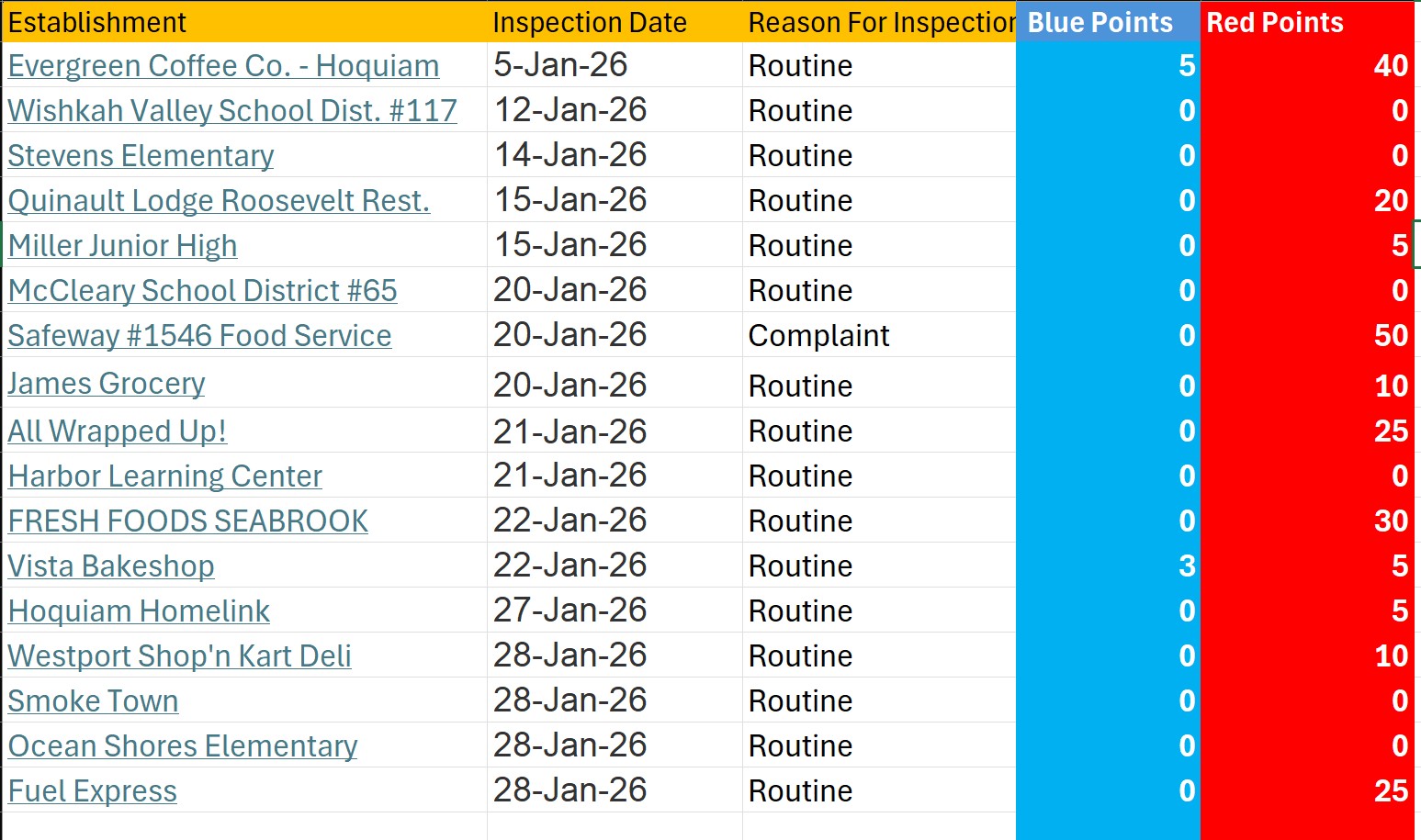
We just went through the latest listings of food and health inspections by the Grays Harbor County Division of Environmental Health.
Please keep in mind, these reports are just being made public, and most establishments have most likely already corrected most issues that they faced. This is all the information we are provided with, so please do not ask much more as far as what the violations were for, etc... For more information, you can contact the Grays Harbor County Division of Environmental Health at (360) 249-4222 or

Before making a judgment on any violations, we encourage our readers to follow up with and check out the actual violations.
Below is listed any restaurants and their violations for any that have exceeded 25 red points during the time period we searched.
Safeway #1546 Food Service -
During a recent health inspection, officials identified multiple violations at a local deli related to unapproved operational changes, food safety, and equipment issues. Inspectors noted that the health department was not notified of significant changes during deli renovations, including alterations to food preparation areas. A handwashing sink lacked hot water but was corrected on site.
Additionally, rotisserie chicken was found stored without proper temperature control and with incorrect time labeling; the product was discarded. Due to the number of critical violations, the establishment was placed on re-inspection status and assessed a $176 re-inspection fee. The deli must notify the health department once construction is complete and normal operations resume, and a meat slicer located in the receiving area must be removed.
Evergreen Coffee Co. - Hoquiam -
A recent health inspection identified multiple food safety and sanitation violations, primarily related to employee training and handwashing practices. Inspectors noted that the person in charge lacked adequate knowledge of key food safety procedures, including proper handwashing and sanitizer use. A food worker was observed washing hands improperly, and required paper towels were missing at several handwashing sinks; these issues were corrected during the inspection.
Additional concerns included the absence of proper sanitizer test strips, improper sanitizer concentrations, drainage issues, and incorrect storage of an ice scoop inside an ice machine. Corrective actions were taken on site, and staff received immediate training. Due to the number of critical violations, the establishment was placed on re-inspection status and assessed a $176 re-inspection fee.
All Wrapped Up! -
A recent health inspection found that ice used for beverages was sourced from an unapproved ice machine and bin, which were not authorized for use. Inspectors also cited the establishment for failing to comply with previously approved plans and variance conditions, including improper plumbing of a mop sink, lack of required air gaps, missing documentation for drainage, and an unrepaired self-closing door hinge. Several required corrections had not been completed by the January 11, 2026 deadline. Additionally, eggs were observed stored above ready-to-eat foods, which was addressed during the inspection.
FRESH FOODS SEABROOK -
During a recent health inspection, improper food storage was observed, including raw chicken stored above raw pork, raw shell eggs and par-cooked steak stored above ready-to-eat foods, creating a cross-contamination risk. Inspectors also found hot foods in a display case being held without required time or date labeling or temperature logs. Unmarked or expired foods were discarded during the inspection. Inspectors noted that opened cheeses must also be properly date-marked unless used within one day.
About The Inspections
These establishments include restaurants, food and espresso carts, coffee places, delis, the fresh food sections in grocery stores, temporary events where food is sold, and more.
There are nearly 500 permitted food service establishments in Grays Harbor County. The majority of these establishments have two unannounced inspections per year. Some food service establishments will receive at least one unannounced inspection annually and any restaurant may request a special educational session.
The purpose of the inspections is to assure that the food is being handled properly from preparation through serving. Inspectors observe kitchen workers' food handling practices, assure equipment is working properly, take food temperatures, inspect refrigerators and storage areas, assure water temperatures, and correct level and use of sanitizers. Any problem found is written up, and the manager is taught the correct procedure or method immediately.
There are two types of violations recorded on the inspection report.
"Red critical violations" are those food handling practices that, when not done properly, are most likely to lead to food borne illnesses. These food handling practices include:
- controlling temperature, such as cooking meats to the right temperature to kill food borne disease germs, keeping food hot enough until it is served, and keeping food cold enough
- cooling food properly, washing hands, and using utensils instead of bare hands on "ready to eat" food
- storing food
- serving practices
"Blue violations" are primarily maintenance and sanitation issues that are not likely to be the cause of a food borne illness.
Each violation has a numerical value based on its risk of foodborne illness. Therefore, there are more points given for red critical violations than for blue violations. Whenever possible, violations found during the inspection are corrected immediately. Red critical items found during the inspection must be corrected immediately. Examples would be re-heating a food to 165° F, putting it into the refrigerator or discarding the food.